
From an empty repository to a living world
The first 140 days of Hearthroot Online, from a local browser prototype to a persistent closed alpha shaped by its players.
I have been meaning to write a Hearthroot devlog for a while. The problem is that there has always been another system to build, bug to fix, balance problem to investigate, or player suggestion that was too interesting to ignore.
So this first devlog is a little different. It is the story of everything that happened before I finally stopped to write one.
Hearthroot began on 23rd February as an empty Next.js project and a fairly modest idea: make a browser RPG where progress continues while you are away, but where the decisions you make while playing still matter.
The first version was barely a game. It had Mining, crafting timers, an inventory and some basic locations. It was originally called Forgeborne Online, which lasted five days before I realised Hearthroot better represented the mixture of industry, exploration and cosy homestead progression I wanted.
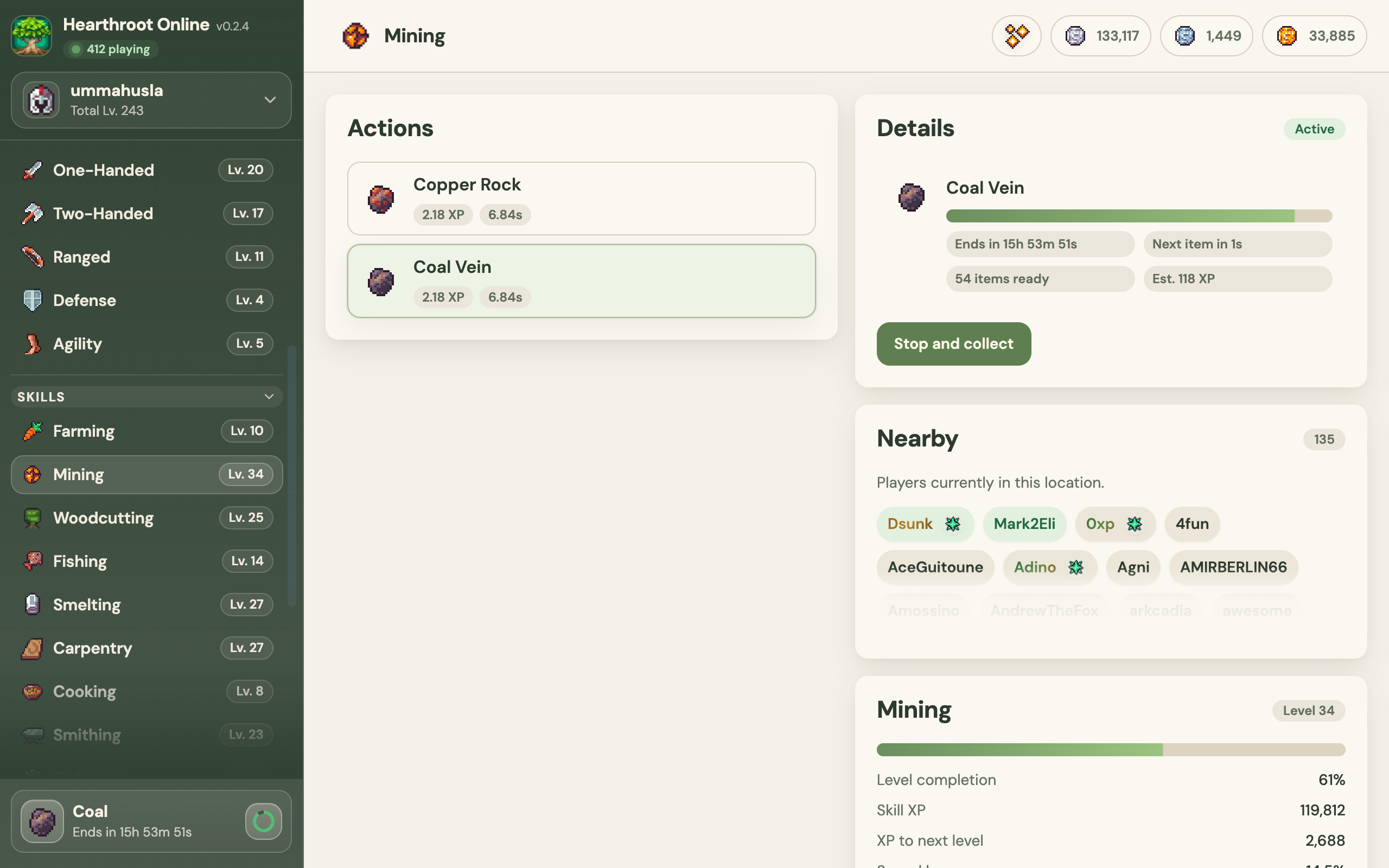
In the 140 days since that first commit, the repository has accumulated 562 commits, 62 database migrations, 37 public releases and 220 individual player-facing patch notes.
It has become much larger than the original prototype.
Finding Hearthroot's identity
The earliest builds were centred on Mining, Smelting, Smithing and Tinkering. You gathered Copper Ore, turned it into bars, made better tools and moved into the next material tier.
That basic loop still sits underneath the game, but it was not enough by itself. A list of increasingly valuable ores is progression, but it is not a world.
Farming arrived in early March. That added persistent plots, crop growth, harvests, compost, earthworms and the beginnings of the Homestead. Daily rewards and Daily quests followed. Combat arrived in April, bringing enemies, equipment, food, drops and separate weapon skills.
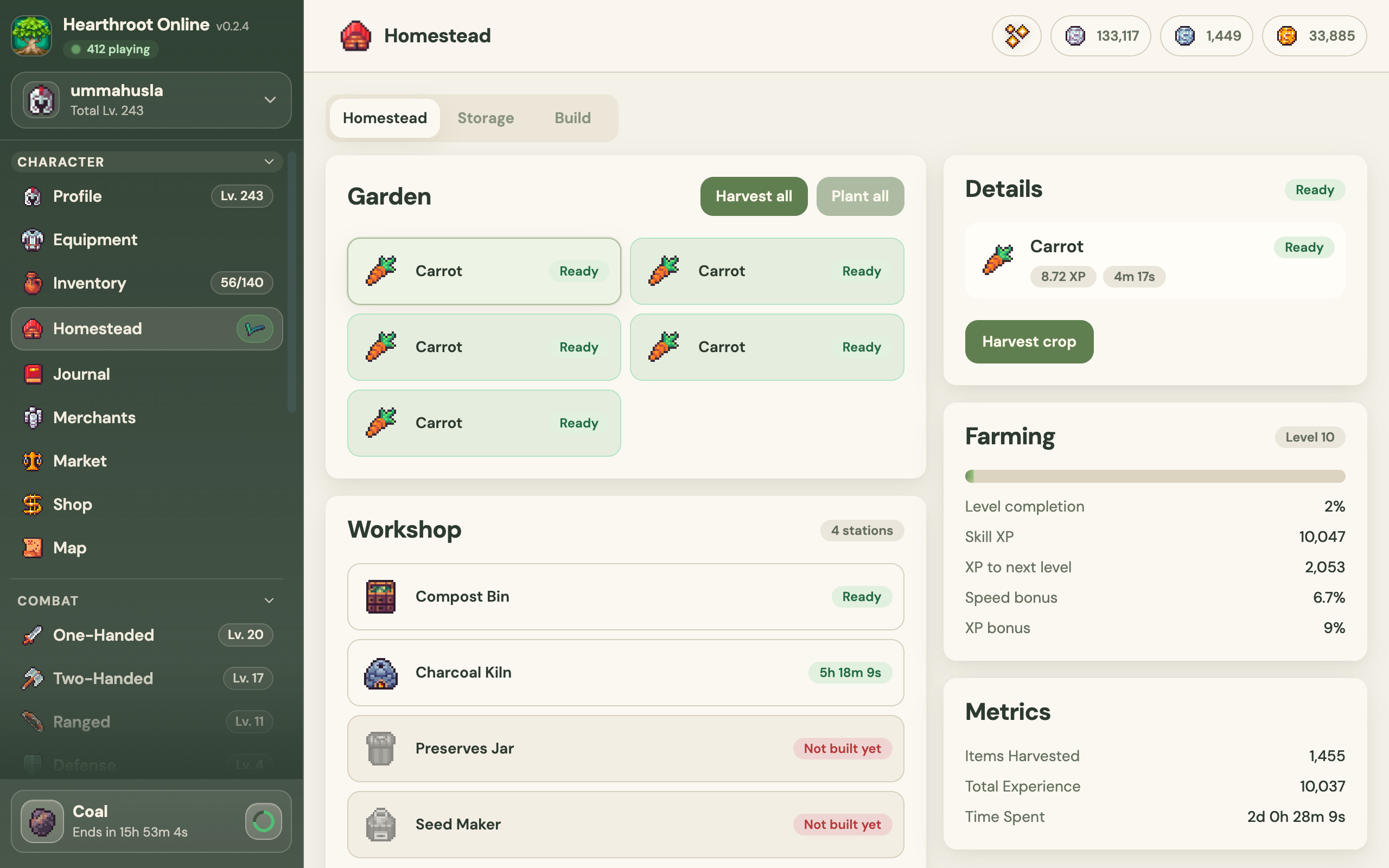
Fishing, Cooking, Homestead stations, Story quests, friendships, player profiles, leaderboards, item quality, chests, keys, unlock tracking and a player-run Market gradually joined them.
The interesting part is that Hearthroot's identity did not come from any one of those systems. It emerged from the connections between them.
Farmers grow ingredients. Fishers bring back food and treasure. Cooks turn those materials into meals. Combat players consume those meals and find equipment or valuable drops. Crafters build the tools everyone needs. Traders connect the whole structure through the Market.
The game started as an idle crafting RPG. It is slowly becoming a small player economy with an RPG attached to every part of it.
Rebuilding the foundation while people were playing
The first versions of Hearthroot stored most progress in the browser. That was useful for proving the game loop quickly, but it was never going to support a persistent online world.
The Supabase migration began at the end of April. Accounts, characters, wallets, inventories, equipment, active sessions, skill XP, farm plots, Market orders, economy events and player presence gradually became canonical database records.
This was considerably harder than simply "saving the game online".
Every mutation must be safe to retry. A duplicated request cannot create items twice. Two purchases cannot buy the same Market listing. A stale browser tab cannot overwrite newer progress. Currency, inventory and Market settlement changes must either all complete or none of them can.
The live database has now processed 313,626 recorded mutation requests. All but seven reached the completed state.
The architecture has already been rebuilt again for multi-character accounts. Characters now own their skills, Silver, equipment, inventory and active work, while Gold, Tokens, Daily quests, Daily rewards, Homestead progress, blueprints and Storage belong to the account.
That ownership boundary sounds obvious after it exists. Implementing it inside a running game was not obvious at all.
There were mistakes. Creating a second character briefly reset shared account progress. Storage contributions failed in some valid cases. Expired Market listings needed rescue paths. A merchant food loop created an arbitrage exploit. Combat protection became too powerful. I even shipped a first World Boss and reverted it on the same day because the supporting game systems were not ready for it.
Those incidents are part of development. The important thing is leaving the underlying system stronger after each one, rather than adding another special case and hoping it survives.
What players have actually done
The live Supabase data is much more interesting than the feature list.
As of 13th July, Hearthroot has:
- 535 registered accounts
- 568 created characters
- 401 characters actively progressing, including offline gathering and crafting sessions
- 273 accounts active during the last seven days
- 325,542 recorded gameplay actions
- 391,926 inventory events
- 1,466 Daily rewards claimed
- A longest Daily reward streak of 63 days
- 91 accepted friendships
- 118 friend invitations
More than half of all accounts arrived during the three-day wave from 2nd to 4th July. Those three days added 292 players, including 120 accounts on 3rd July alone.
The biggest surprise is what those players chose to do.
There have been 106,039 planting actions and 105,089 harvests. Together, Farming represents almost 65% of every recorded gameplay action.
Players have produced:
- 2,716,722 Copper Ore
- 2,102,602 Coal
- 2,000,229 Willow Logs
- 1,417,254 Earthworms
- 956,279 Iron Ore
- 754,928 Copper Bars
I did not predict that Hearthroot's closed-alpha economy would contain more than 1.4 million earthworms, but here we are.
The Market has processed 3,316 completed trades across sell listings and buy orders. Those trades moved 856,510 item units with a combined value of 12,815,017 Silver.
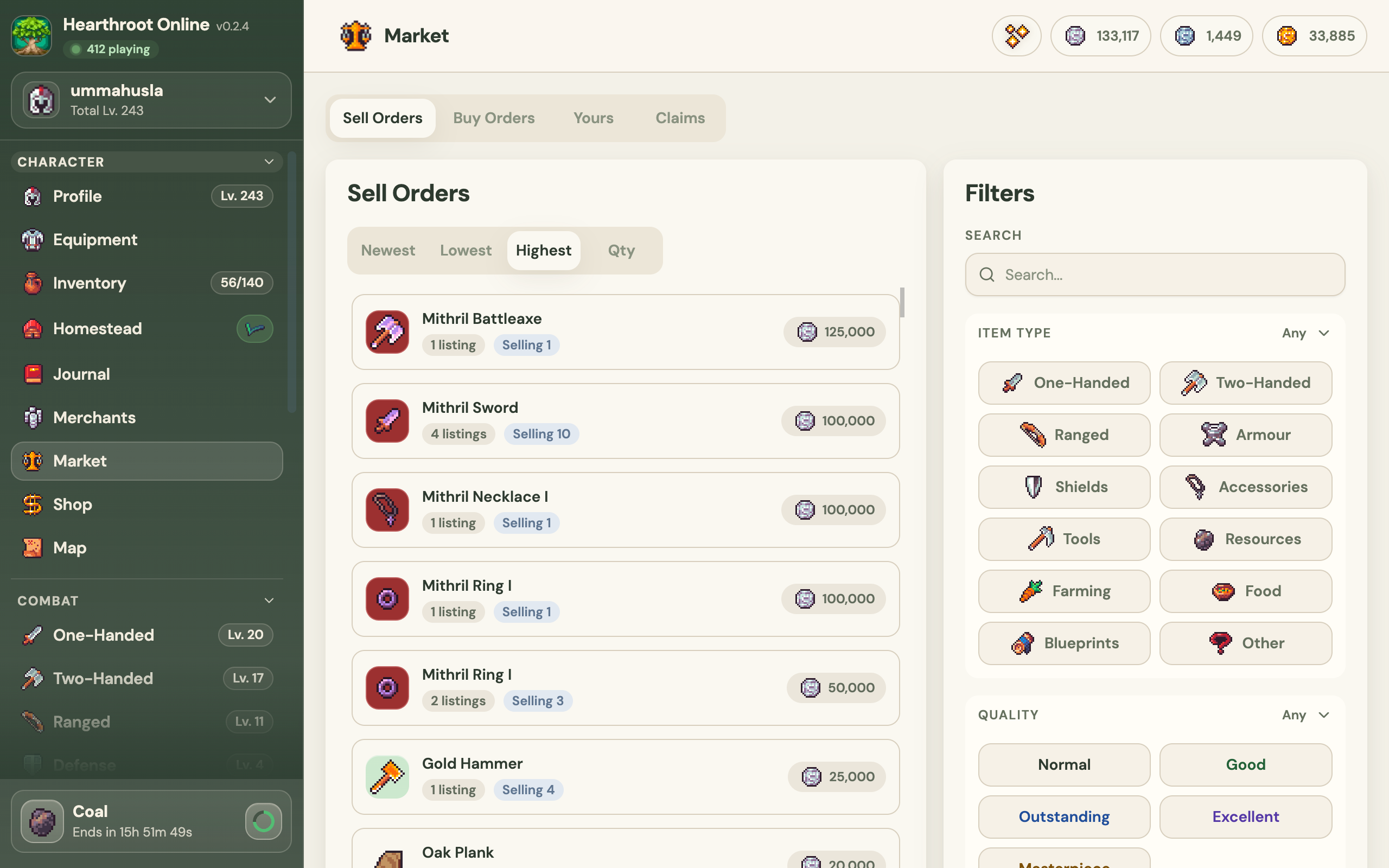
Coal has generated the most broad trading volume. Mithril Pickaxes are the opposite story: only eight have traded, but together they represented more than 1.15 million Silver. That is exactly the kind of distinction I hoped a player economy would create - bulk commodities at one end and rare, high-value progression items at the other.
Combat progression has also become surprisingly specialised. Ranged has accumulated the most XP across the game, followed by One-handed and Two-handed combat. Mining remains the most widely played profession, with more than 430 characters earning Mining XP.
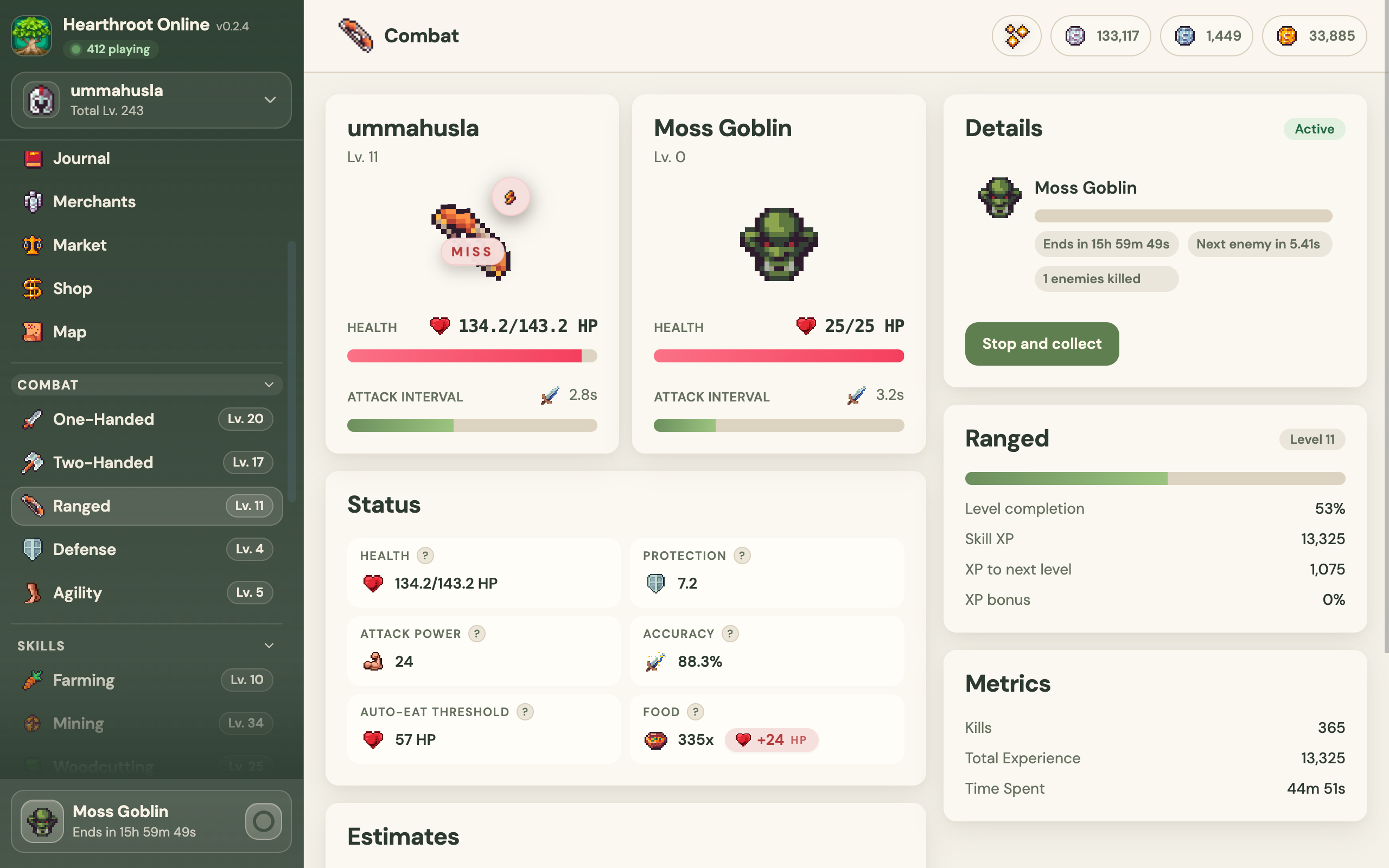
These numbers have already changed how I think about development priorities. The Homestead is not a decorative side system. The Market is not just a convenient exchange screen. They are central parts of how players experience Hearthroot.
The road to v0.2
The last few weeks have moved particularly quickly.
Cooking connected Farming, Fishing, Woodcutting and Combat. Friends and Homestead visits gave characters a reason to exist beyond leaderboards. Membership, appearance settings and the Gold shop established the commercial systems, although payments remain in sandbox mode while those flows are tested.
Market buy orders turned trading from a one-sided listing board into a proper exchange. The Journal gained a 30-quest starter story. Public updates, a marketing homepage and the first generated Wiki began exposing Hearthroot outside the signed-in game.
Version 0.2.0 was the largest structural release so far. It introduced the real account-versus-character ownership model, independent simultaneous character progression and shared account Storage.
Version 0.2.1 then reworked Combat protection, accuracy and enemy progression, added kill requirements before Elites and Bosses, improved Storage and corrected several progression economies. Food crops received triple yields, Fishing XP doubled and higher-tier crafting XP was rebalanced.
Today, v0.2.2 expands the Daily Journal to 14 possible quests per reset, covering every non-Agility skill with clearer progression requirements.
This pace has been exciting, but it also carries a cost. Every new connection multiplies the number of interactions that must be balanced and protected. A Farming adjustment can change Cooking supply, Combat sustain, Market prices and leaderboard competition at the same time.
Hearthroot is now at the point where systems cannot be balanced in isolation.
What comes next
The immediate priority is not simply adding more features. It is making the existing world deeper, clearer and harder to break.
That means better operational tooling, broader end-to-end testing, clearer early-game guidance, stronger progression beyond the current content bands and more reasons for players to specialise and trade.
The account and character migration also gives Hearthroot the foundation it needs for a clean beta. The current plan is for beta to begin this Friday, 17th July, with a fresh game state, while everything learned from the closed alpha shapes the balance and structure players start with.
There will still be new content. More locations, enemies, quests, items and reasons to visit other Homesteads are natural directions. But I want each addition to strengthen the relationships already forming between gathering, crafting, combat, farming and trade.
The most encouraging part of the last 140 days is that Hearthroot no longer feels like a collection of systems waiting to become a game.
Players are choosing professions, growing absurd quantities of crops, hoarding earthworms, chasing combat levels, forming friendships and moving millions of Silver through a market that did not exist two months ago.
There is still an enormous amount to build.
But the world is alive now.
And this is only devlog number one.
All player statistics are aggregate snapshots from the live closed alpha, captured on 13th July 2026. No player-identifying data is included. Payments remain in Stripe sandbox mode and are deliberately not presented as revenue.