
A map you can read
The Hearthroot world map gets a proper explorer's layer: routes to trace, regions to search, and a living beacon for where your character is now.
Hearthroot has had a map for a while. It showed the locations, the roads between them and the little icons that make the world feel more like a place than a menu.
But a map can be technically correct and still not be very useful.
The new map is built around a simpler question: where do you want to go next?
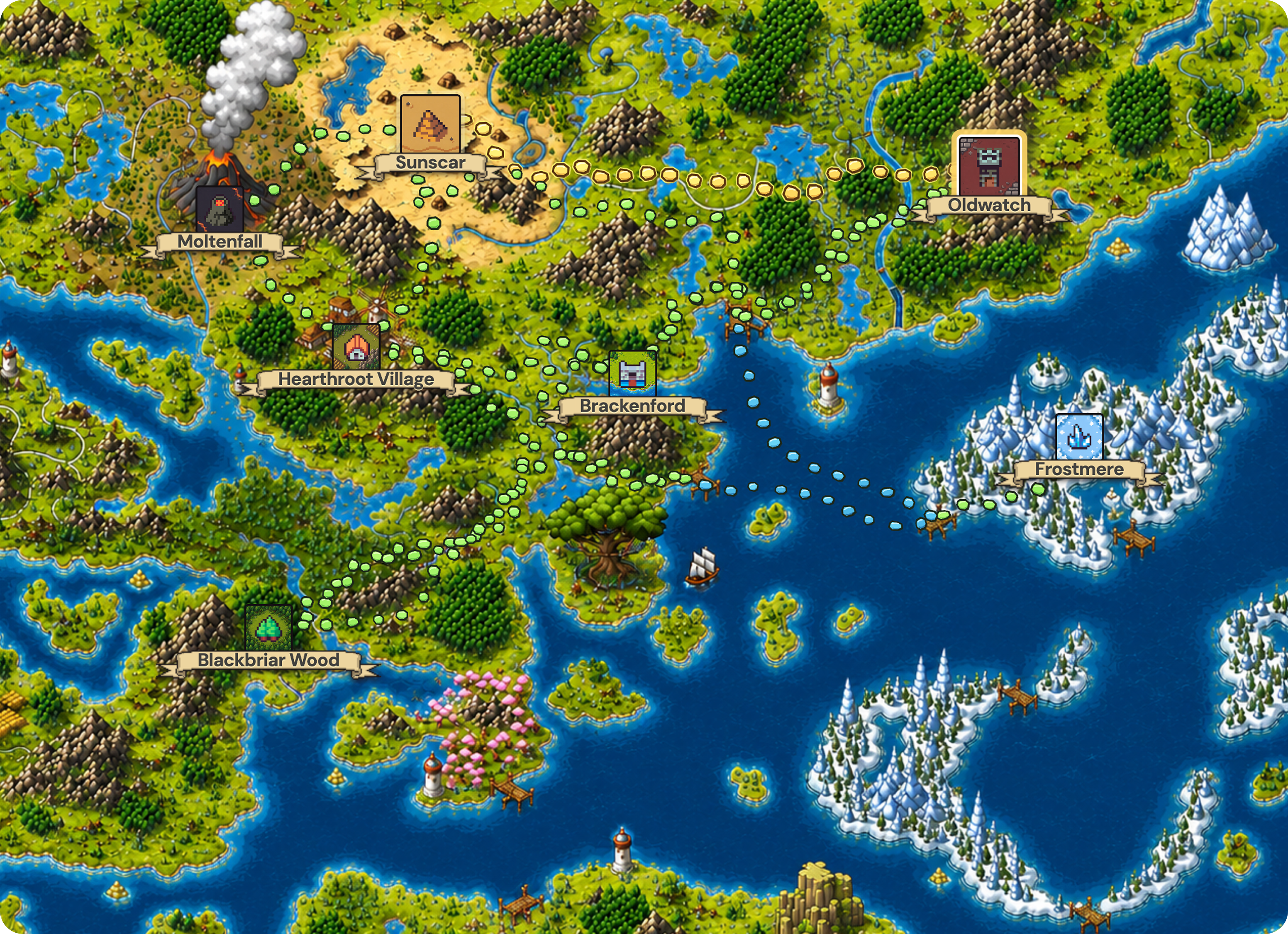
A world that invites investigation
The map now has dedicated world map controls beside it, but the change is bigger than another panel of buttons.
You can search for a region or resource, jump straight to the next frontier, return to your current region, or select any location from the result list. Selecting a destination moves the map to it and traces the route from where your character is standing.
That last part is important. A destination should not feel like an isolated button. The route is part of the decision.
Do you want to make the short trip to Brackenford for Iron? Are you planning a longer journey towards Frostmere and its Azure deposits? The map should answer those questions before you open the travel panel.
The route is a feature
The visible routes come from the same map data that drives travel time. The drawn paths are not decorative lines maintained separately from the game. They are the source used to resolve which roads, mountain passes and water crossings connect each location.
That gives us a useful foundation for future exploration systems:
- A route can become dangerous without changing the destination itself.
- A harbour or shortcut can change the best path through the world.
- A quest can point to a location and highlight the journey rather than only naming the endpoint.
- New map layers can show discoveries, events, guild activity or seasonal changes.
The current version keeps travel instant in the game rules, but the map still shows the shape of the journey. This lets the world feel larger now while leaving room for more meaningful travel decisions later.
Magic, shortcuts and the wider world
The map is arriving alongside two other recent additions to the world.
Magic is now a full combat skill, with staff progression from Copper through Adamant and its own place in combat matchups. It gives players another way to approach enemies and another long-term progression path to plan around when choosing a destination.
The Scroll of Teleport also gives explorers a shortcut. Scrolls can be used from the Map or Inventory to move instantly between locations, turning a long route into a deliberate choice: travel normally and keep the scroll, or spend one when the destination matters now.
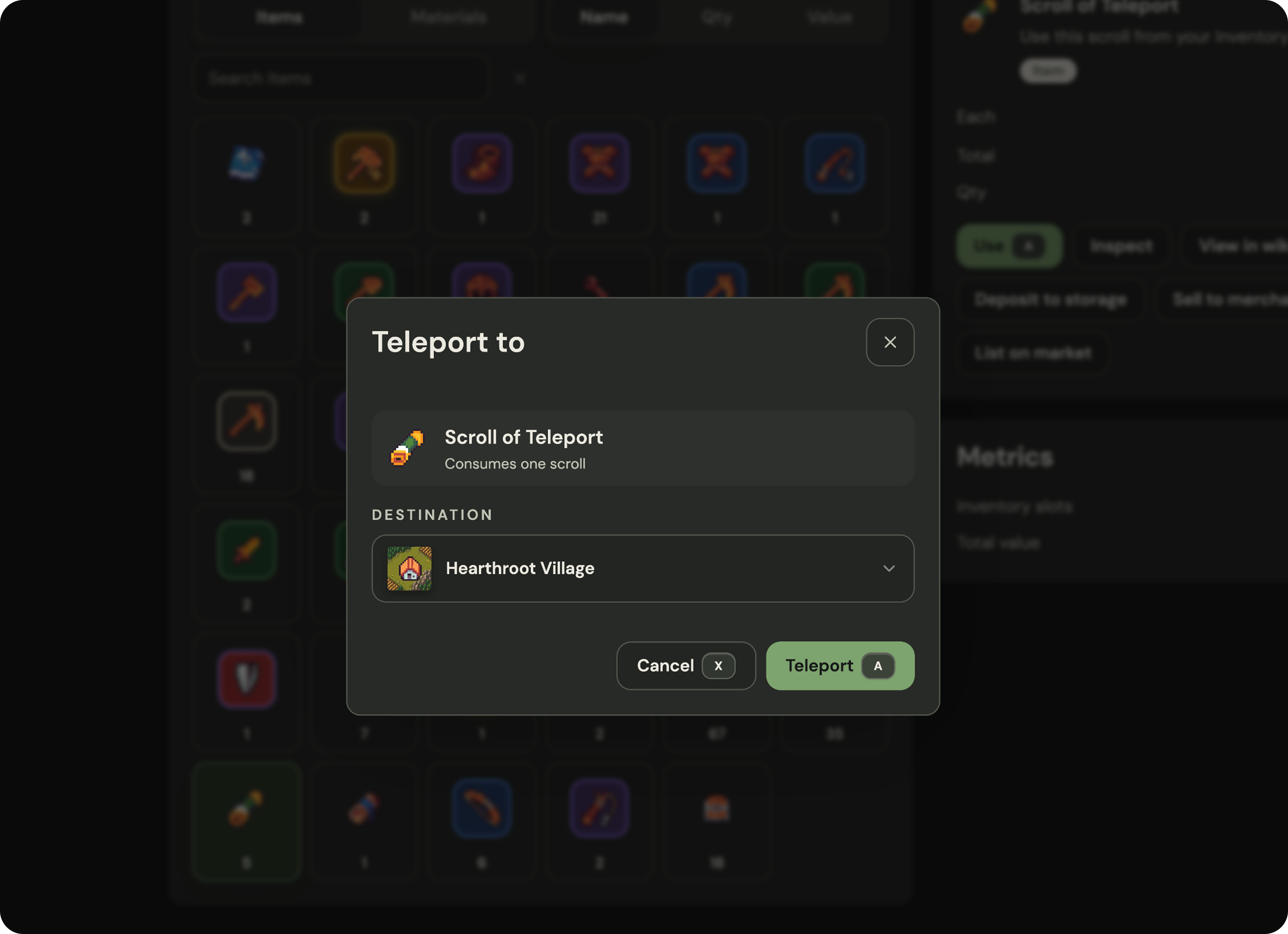
A living position marker
Your current location now has a soft pulse on the map. It is a small detail, but it solves a surprisingly common problem: after zooming out, it was easy to forget which marker represented you.
The world map controls can quickly return to your current region after you have been looking around the frontier. The map remembers its layer preferences as well, which means you can keep the view focused on locations or routes without resetting it every time.
The goal is not to add more controls for their own sake. It is to make the map feel like a tool carried by an adventurer - something you inspect, read and use to make a plan.
Seven regions, one world
The first version of the world map contains seven mapped regions:
- Hearthroot Village, the home settlement and starting point
- Brackenford, where Iron and Oak mark the first real step outward
- Blackbriar Wood, with Gold veins beneath its forest roads
- Oldwatch, a ruined mountain settlement rich in Mithril
- Sunscar, where Verdant ore sits beneath the heat
- Frostmere, the Azure frontier
- Moltenfall, the current end of the mining road
Each location already has its own gathering routes, enemies, nearby features and progression band. The interactive map finally gives those places a shared shape.
That is the part I am most excited about. The next location is no longer just the next entry in a list. It has a position, neighbours, a route and a reason to be there.
What comes next
This is the first pass, not the final cartography system.
The most obvious future additions are map discoveries, temporary events and more layers that explain what is happening in the world right now. I would also like the map to become more useful for quests, guild projects and player-made routes without turning it into a noisy dashboard.
For now, the important change is that the map can be read at a glance:
You are here.
That is the road there.
And this is what waits when you arrive.
That feels much closer to the world Hearthroot is trying to become.